
Chess Mastery
Strategic Thinking for Kids
Empower your child with the ultimate mind sport. Join our highly engaging program designed to build essential cognitive skills for a lifetime of success.
Why Kids Should Learn Chess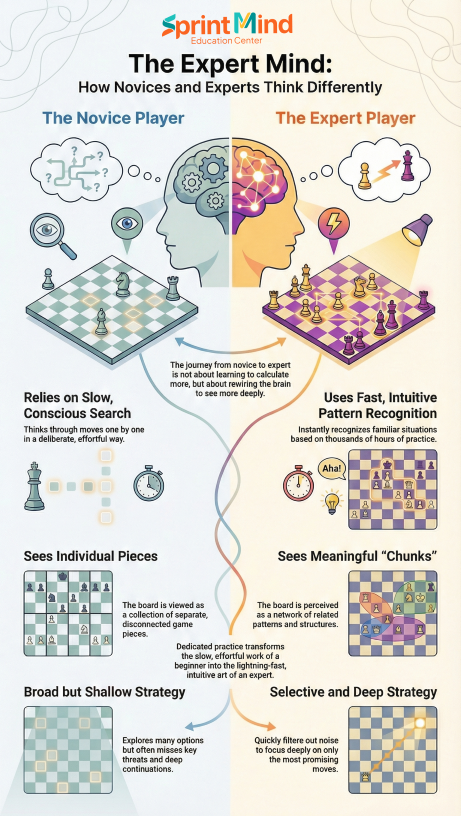
Experience Sprintmind
From the Classroom to the Provincial Board: Individual Medals, Team Triumphs.
Starts Here!
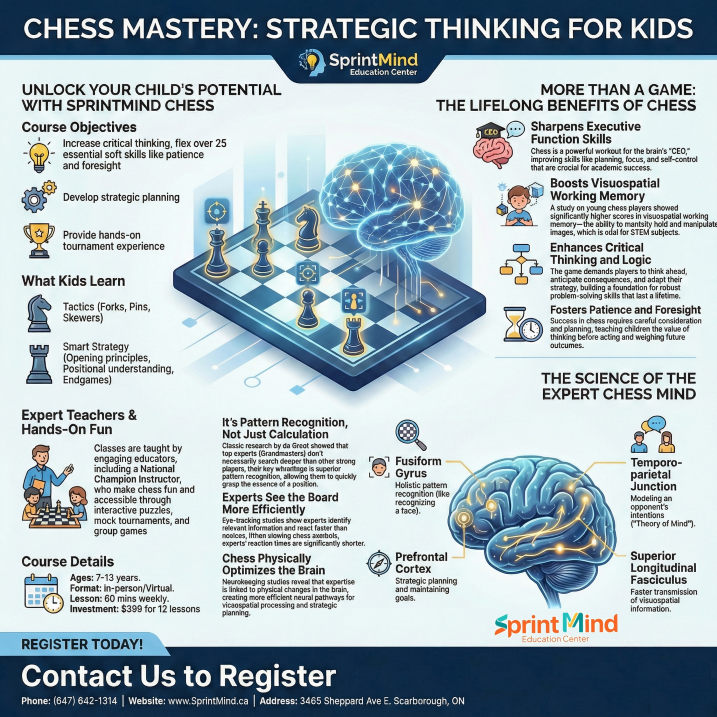
Course Objectives
Critical Thinking
Increase children's critical thinking & problem solving capabilities.
Soft Skills
Flex over 25+ human essential soft skills including Patience & Foresight.
Strategic Planning
Develop strategic planning and deep pattern recognition.
Tournament Prep
Gain hands-on, practical tournament experience.
Fundamentals
-
A Fun Introduction to Tactics: Forks, Pins, Skewers
-
Smart Strategy: Opening principles, Positional understanding, Endgames
Hands-On Activities
- Interactive Puzzles
- Mock Tournaments
- Fun Exercises
- Engaging Group Games
How Does Chess Make Kids Smarter?
The Science Behind SprintMind's Chess Program
The Short Answer
Scientific research reveals that chess mastery isn't about rote calculation, but about developing exceptional pattern recognition through a process called "chunking." Learning chess significantly enhances a child's visuospatial working memory, building highly efficient neural pathways that filter out irrelevant information. This translates directly to faster, sharper decision-making in academics, STEM subjects, and everyday life.
Core Cognitive Advantages of Chess:
- • Deep Strategic Thinking: Experts don't calculate every move; they use highly developed intuition to analyze "fewer but better" options.
- • Massive Pattern Recognition: Trained children can store thousands of board patterns in their memory, allowing them to instantly see the core of a complex problem.
- • Activating Key Brain Regions: Chess actively stimulates the temporal lobe (for object recognition) and the temporo-parietal junction (for understanding others' intentions).
- • Under-Pressure Filtering: The brain learns to block out "noise" in milliseconds to identify crucial breakthroughs during stressful situations.
How do chess masters actually think? Do they calculate more moves than beginners?
Contrary to popular belief, masters do not calculate further ahead than average players initially. Adriaan de Groot’s classic 1946 psychological study proved that the real difference lies in their search strategy. Masters rely on a vast visual memory bank to instantly eliminate dead ends and focus only on viable paths.
At SprintMind, we utilize this exact scientific principle. We abandon rote memorization and focus on helping students build efficient "chunking" visual patterns, teaching them to see the board like a grandmaster from day one.
Why is early childhood the best time to learn chess?
Cognitive science shows that ages 5 to 6 are the critical window for building dense neural connections. Children trained in chess during this period gain a distinct, lasting advantage in tracking object locations and visuospatial working memory—skills directly linked to future math performance.
At the SprintMind Education Center in Scarborough and Markham, we focus on laying this cognitive foundation early. Following our core philosophy—"SprintMind offers the roadmap of success"—our chess program isn't just a game; it is a fundamental stepping stone for future success in STEM and advanced mathematics.
How does chess intuition translate to real-world decision-making?
Eye-tracking technology reveals that expert players have fewer visual fixation points and a wider field of vision. They look at the "relationships" between pieces rather than individual pieces.
Our professional teaching team integrates this "rapid key information locking" into every class. By training students to quickly grasp the relationship between moving parts, we help them rely on highly trained intuition to make the best decisions when facing complex academic challenges or life choices.
Frequently Asked Questions (FAQ)
About SprintMind's Chess Program
Can my child learn this "pattern recognition" without any prior chess experience?
Can chess physically change the structure of the brain?
Where are SprintMind's classes held?
Cited Scientific References
- De Groot, A. D. (1946). Thought and choice in chess. (Foundational research on the search strategies and visual memory of chess masters).
-
Chase, W. G., & Simon, H. A. (1973). Perception in chess. Cognitive Psychology. (The origin of the "Chunking" theory in cognitive science.
View Source →) -
Ontario Ministry of Education. (2014). Paying Attention to Spatial Reasoning. Support Document for Paying Attention to Mathematics Education.
(View Document →)
Expert Teachers
Taught by engaging educators who know exactly how to make chess fun, accessible, and highly rewarding for children of all levels!
The Center
3465 Sheppard Ave East
Scarborough, ON M1T 3K5
Ready to Make Your Move?
Secure your child's spot in our upcoming Chess Mastery program. Spaces are limited!
Register NowPlease register with the link above.