
Introduction: The Myth of the Human Supercomputer
Picture the chess master: a lone genius with a mind that calculates millions of moves into an incredibly complex future. This image is powerful, but it is also misleading. Research shows a more interesting truth: expert chess players are not primarily calculators; they are masters of perception. Their real strength lies in recognizing meaningful patterns, a skill developed through thousands of hours of dedicated practice.
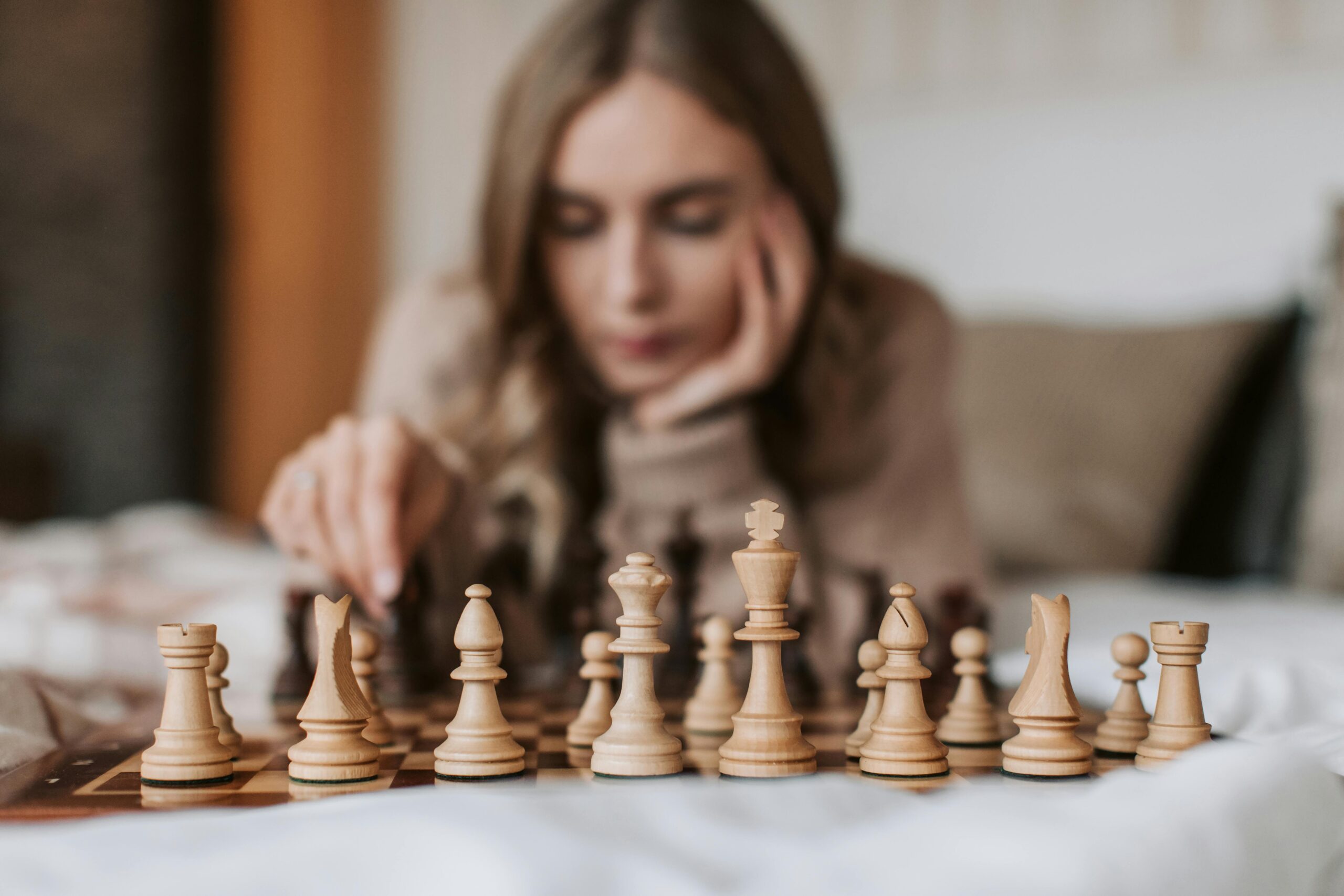
This guide will look beyond the myth of brute-force calculation. We will uncover the remarkable changes in the human brain under pressure, where careful logic turns into effortless understanding. We will examine the real, evidence-based differences in how novice and expert players think, exploring the science behind highly trained intuition.
1. Busting the Biggest Myth: It’s Not About Seeing More Moves
The most enduring myth about chess masters is that they can out-calculate everyone, looking deeper into the game’s future. However, foundational research reveals a much more complex reality.
1.1 The Famous Study Everyone Gets Wrong
In a key 1946 study, Dutch psychologist Adriaan de Groot asked chess players of various skill levels to “think aloud” while analyzing a position. His main finding was that there was surprisingly little difference in the search patterns—the number of moves considered and the depth of the search—between “super experts” (Grand Masters) and “ordinary experts” (Candidate Masters). Over the years, this finding has been misquoted in textbooks and articles. Many incorrectly claim that de Groot found no difference in search between experts and novices. This misunderstanding obscures the significant differences between skilled players and novices.
1.2 The Real Difference in Search Strategy
When comparing the performance of de Groot’s Grand Masters to novices (using data from a later study by Gruber), a clear and pronounced difference appears. Although both groups may spend a similar amount of time on a problem, their thinking processes are fundamentally different.
| Metric | Key Finding |
|---|---|
| Search Depth | Experts search significantly deeper. Grand Masters pursue promising lines of play much further than novices, analyzing the consequences of a sequence more thoroughly. |
| Number of Investigations | Experts evaluate more strategic ideas. While they may consider a similar number of initial moves, they explore a broader range of overall plans and strategic possibilities. |
| Quality of Move | Experts choose far better moves. Unsurprisingly, the expert’s deeper search leads them to select moves that are superior compared to novices. |
This shows that experts don’t just search more; they search smarter. Their ability to go deeper on fewer, better options isn’t just raw calculation. It arises from a perceptual system, refined through practice, that quickly identifies which paths to explore and which are dead ends.
2. The True Secret: Experts See the Board Differently
The essence of chess expertise is not superhuman calculation but a well-developed perceptual skill. Through extensive practice, experts build a vast mental library of patterns that enables them to understand a position almost instantly.
2.1 From Pieces to Patterns: The Power of “Chunking”
Researchers William Chase and Herbert Simon introduced the concept of “chunking” to explain this idea. They suggested that experts do not see a chessboard as 32 individual pieces but rather as a collection of meaningful, interrelated patterns, or “chunks.”
A chunk could represent a common pawn structure, a typical attacking formation, or a defensive setup. After thousands of hours of practice, an expert develops an extensive vocabulary of these configurations, with recent estimates suggesting as many as 300,000 chunks. This allows them to view the game holistically, similar to how a fluent reader processes words and sentences instead of individual letters.
2.2 Proof from Eye-Tracking: A Window into the Expert Gaze
Modern eye-tracking studies provide insight into this process, showing what experts actually focus on. When looking at a structured chess position, experts’ gaze patterns differ from novices’ in three significant ways:
-
Fewer Fixations: Experts need fewer eye movements to understand the board. Their glances capture a larger, more meaningful chunk of information, allowing for quicker position assessment.
-
Fixating Between Pieces: Novices typically look directly at the pieces, while experts often fixate on empty squares between related pieces. This shows they are not just identifying pieces—they are actively processing relationships within a chunk (e.g., attack, defense, control of a key square).
-
Larger Visual Span: With each fixation, experts can take in a larger area of the board. This “visual span” helps them absorb more relational information at a glance, thus improving their speed and efficiency.
2.3 The “Perceptual Specificity” Test
How do we know this skill is rooted in visual patterns instead of merely in abstract strategic knowledge? An inventive experiment provides the answer. Researchers had experts and novices complete a chess task under two conditions:
- Familiar Symbols: Pieces were represented by their typical icons (e.g., ♞).
- Unfamiliar Letters: Pieces were replaced with letters (e.g., ‘N’ for knight, ‘B’ for bishop).
Both conditions presented the same chess problem. The results were striking: the expert’s speed advantage decreased significantly or even disappeared when using the unfamiliar notation. This showed that their expertise is closely tied to a visual memory of familiar patterns. When that visual familiarity was disrupted, their rapid, intuitive processing faltered.
These perceptual skills aren’t magic. They arise from physical changes in the brain developed through years of dedicated practice.
3. A Glimpse Inside the Expert Brain
Neuroscience sheds light on the biological foundations of chess expertise, revealing how the brain adapts to the game’s demands.
3.1 Building a Better Visuospatial “Engine” from Childhood
The cognitive skills for chess seem to develop from an early age. A study of 5- to 6-year-old children found that those who attended chess classes had significantly stronger visuospatial working memory, especially in recalling the locations of objects on a grid. This suggests that tracking pieces and positions on a board actively trains this crucial cognitive ability from the start of a player’s journey. Such foundational training in visuospatial processing during childhood appears to pave the way for the specialized, expert brain that emerges in adulthood.
3.2 Pattern Recognition on Autopilot
Neuroimaging studies confirm the necessity of pattern recognition at a neural level. When experts view chess positions, they show more activation in brain areas linked to object and pattern recognition, including the temporal lobe. This supports the behavioral evidence that their perception of chess “chunks” becomes a swift, automatic, and highly practiced skill, much like how the brain automatically identifies everyday objects.
3.3 Thinking About the Opponent’s Thinking
Chess isn’t just about patterns; it’s about anticipating an opponent’s intentions. Functional MRI (fMRI) studies have shown that playing chess activates brain regions tied to “Theory of Mind” (ToM)—the ability to understand the mental states, beliefs, and intentions of others.
Chess activates areas like the right temporo-parietal junction (TPJ), a crucial hub in the social brain. This means that chess thinking involves actively “mentalizing” about the opponent, modeling their possible plans, and reasoning through their choices. This combination of sharp perception and specialized brain functions enables experts to perform with remarkable efficiency during a game.
4. From Perception to Action: The Art of Efficient Thinking
An expert’s perceptual advantages directly lead to better decision-making. They don’t just see the board more clearly; they use that clarity to think and act effectively.
4.1 Zeroing in on What Matters—Instantly
In one study, researchers created chess problems where changing a single piece (e.g., from a bishop to a knight) completely changed the “relevancy map” of the board, making a previously significant area irrelevant and vice versa.
The findings were telling. While both experts and novices eventually looked more at the relevant squares, there was a crucial difference in timing:
This demonstrates an almost instant ability to separate important information from the noise. The expert’s brain acts like a top-notch autofocus system, quickly highlighting critical elements while keeping the background blurred. In contrast, novices rely on manual focus, gradually adjusting their view across the board to figure out what matters.
4.2 Intuition as Highly-Trained Recognition
This brings us back to the idea of expert “intuition.” This is the real essence of expert intuition. It isn’t magic or a mysterious gut feeling. It is the mind’s ultimate shortcut: a vast library of experience that can be accessed in milliseconds, presenting solutions not as calculations but as self-evident facts.
The Novice Approach
The novice depends on a slow, conscious, and effortful search, checking one move after another carefully.
The Expert Approach
The expert relies on fast, automatic, and largely unconscious pattern recognition, quickly producing the most promising moves while eliminating irrelevant options.